
Understanding Potencies (6X, 30C, 200C): Myths and Realities
The world of homeopathy is often perceived as a mystery, especially when it comes to the numbers and letters found on those small blue vials. If you have ever stood in a health food store wondering whether to choose a 6X, 30C, or 200C remedy, you are not alone. These labels refer to the potency or strength of the medicine, and understanding them is the key to using homeopathy effectively.This guide will demystify the science (and the art) of homeopathic potencies, debunk common myths, and provide you with a professional perspective on how to navigate your healing journey.

The Foundation: What is Homeopathic Potency?
In conventional medicine, "strength" usually refers to the amount of active ingredient—for example, a 500mg tablet has more substance than a 200mg tablet. In homeopathy, however, potency refers to the number of times a base substance has been diluted and "succussed" (vigorously shaken).
The Process of Potentization
Homeopathic remedies are primarily derived from natural sources: plants, minerals, or animal products. The manufacturing process involves two critical steps:Serial Dilution: The original substance (the "mother tincture") is diluted in a specific ratio of alcohol or water.Succussion: Between each dilution step, the mixture is vigorously shaken.For substances that do not dissolve easily, such as minerals or metals, a process called trituration (grinding with lactose powder) is used before the substance can be turned into a liquid potency. This combined process is known as potentization, and it is believed to activate the "energy" of the original material while removing its toxic properties.
Decoding the Labels: X vs. C Scales
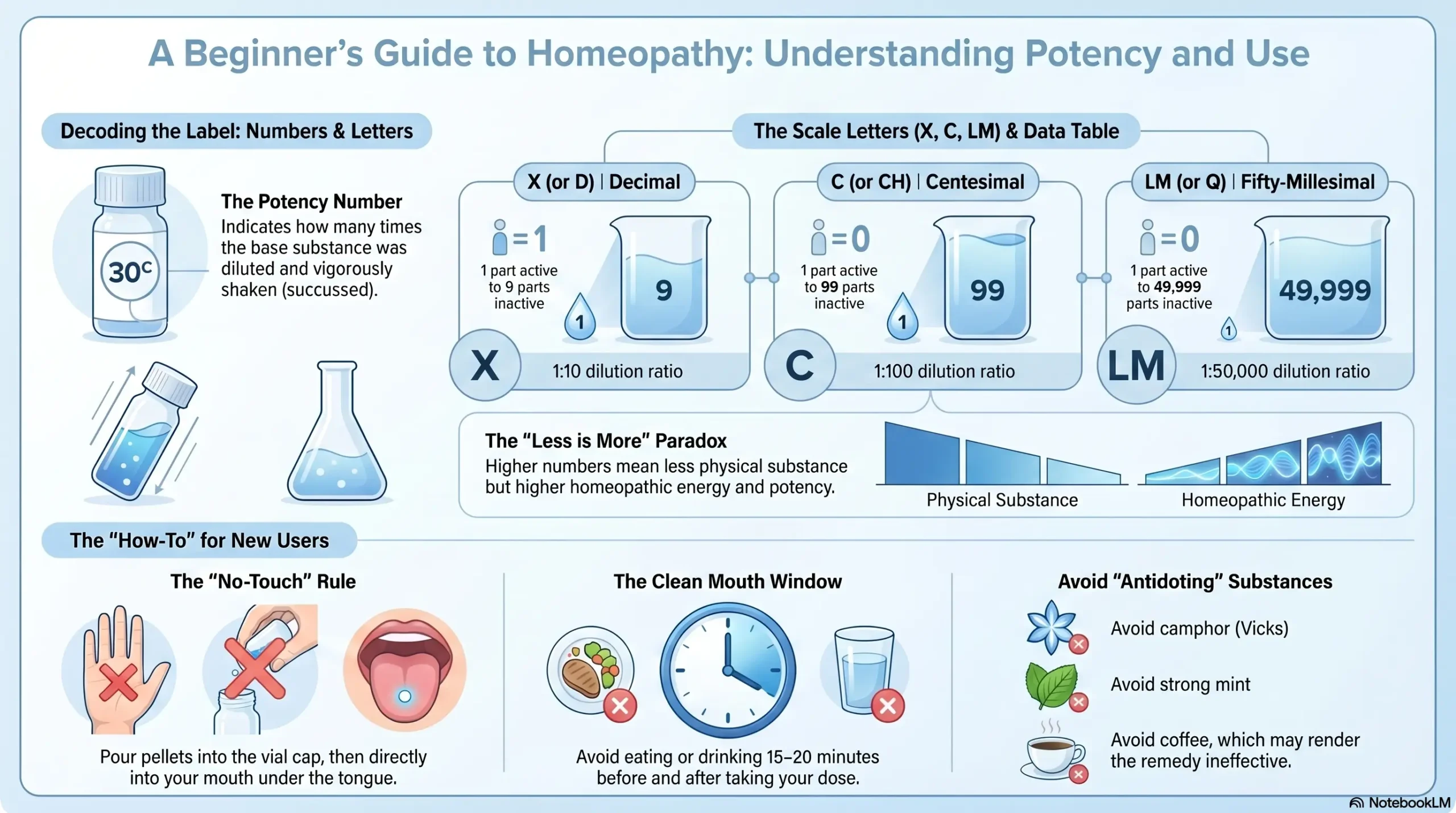
When you look at a remedy, you will see a number followed by a letter. The letter tells you the ratio of dilution, and the number tells you how many times that ratio was applied.
The Decimal Scale (X or D)
The X scale (also known as "D" in Europe) uses a 1:10 ratio.1X: One part original substance to nine parts diluent.6X: This process has been repeated six times.Traditional Use: 6X is the standard potency for Schuessler Cell Salts, which focus on supplying micro-doses of minerals directly to the cells.
The Centesimal Scale (C or CH)
The C scale (often written as "CH" to indicate the Hahnemannian method) uses a 1:100 ratio.1C: One part substance to 99 parts diluent.30C: This process has been repeated 30 times.Traditional Use: This is the most versatile scale, used for both acute and chronic conditions.Key Reality Check: Because the dilution ratio is much larger in the C scale, a 6C potency is much more dilute than a 6X potency, even though the number is the same.
The Potency Paradox: Why "Less" is "More"
One of the biggest hurdles for newcomers to homeopathy is the idea that a 30C is "stronger" than a 6X, even though the 30C contains less physical material.In homeopathy, the higher the number, the deeper and longer-lasting the effect is believed to be. While the physical substance decreases with each dilution, the "energy" or "potency" of the medicine is said to increase through succussion.
A Quick Selection Guide
Low Potencies (6X, 6C): These are best for local symptoms you can "point a finger at," such as a bruise, an insect bite, or mild indigestion. They are often repeated more frequently.Medium Potencies (12X, 30X, 12C, 30C): These are used for general symptoms affecting more than one location, such as muscle aches or a fever. 30C is the most common potency for self-care.High Potencies (200C, 1M, 10M): These are typically reserved for deep-seated conditions, emotional traumas, or very high-intensity acute situations. Because they act so deeply, they are taken less frequently.
Common Myths vs. Realities
Myth 1: Homeopathy is just a placebo because it’s "nothing but water."
Reality: While many homeopathic potencies (those above 12C or 24X) are "sub-molecular"—meaning they likely contain no original molecules—homeopathic theory posits that the water holds a memory or energetic imprint of the substance. Millions of people worldwide, including those using it for infants and animals (where the placebo effect is less likely), report significant results.
Myth 2: Taking more pellets makes the dose stronger.
Reality: In homeopathy, a dose is the frequency, not the quantity of pellets. Taking five pellets at once is considered the same as taking one pellet. What matters is how often you take the remedy (e.g., once an hour vs. once a day).
Myth 3: You can’t touch the pellets with your hands.
Reality: This is actually true. You should avoid touching the pellets to prevent contamination from oils or scents on your skin. Most vials are designed so you can pour the pellets directly into the cap and then into your mouth.
Myth 4: Homeopathy works instantly.
Reality: It depends on the situation. In acute emergencies like a bee sting, results can be immediate. For chronic conditions, healing is a gradual process. A general rule is that for every year you have had a condition, it may take 1-3 months to resolve.
Understanding Healing Reactions: What Happens Next?
Once you take a remedy, your body begins a process of "internal spring cleaning". You may experience one of three responses:A Curative Response: Symptoms improve gradually without complications.An Aggravation: Symptoms may temporarily worsen. This is often a great sign that the body’s healing mechanism has been stimulated. It is usually short-lived (24–48 hours).Return of Old Symptoms: In deep healing, old aches or even traumatic memories from the past may briefly resurface. This is considered a sign that the body is resolving suppressed issues to achieve wholeness.
Proper Care and Administration
To ensure your remedies remain effective, follow these professional guidelines:Storage: Store remedies at room temperature in a dry, dark place. Avoid exposure to bright sunlight, moisture, and strong odors like perfumes or essential oils.The "Clean Mouth" Rule: Do not eat or drink 15–20 minutes before and after taking your remedy. Pellets should be placed under the tongue to dissolve.Avoid Antidotes: Certain substances can "render the remedy ineffective." Common interferences include camphor (Vicks, Tiger Balm), strong mint (toothpaste, gum), and dental work involving high-powered drilling.
How to Track Your Progress
Because homeopathy is holistic, it affects your emotions and energy as much as your physical symptoms. It is highly recommended to keep a symptom tracker with four columns:Symptom List: (No more than ten).Duration: How long you have had the symptom.Impact: The degree of impact on your daily life.Importance: How important it is for you to resolve this.Updating this list regularly will serve as a roadmap for your healing progress, helping you and your practitioner determine if a change in potency or remedy is needed.
Conclusion
Understanding homeopathic potencies—6X, 30C, and 200C—empowers you to take charge of your health with confidence. Whether you are using cell salts for daily mineral support or a high potency remedy for an acute fever, the key is to observe your body’s unique language.While low potencies are safe for home use, always consult a professional homeopath for chronic or complex conditions. Homeopathy is not just about "curing" a symptom; it is about supporting your body’s vital force as it navigates the journey back to balance.